The APP_DEBUG Trap and Safe Production Observability
Setting APP_DEBUG=true in a live environment is an immediate security incident. We've all seen screenshots on social media showing database credentials, AWS keys, and mail passwords leaked because an unhandled exception rendered Ignition or Flare in production. Turning off debug mode stops sensitive leaks, but it leaves you blind when a 500 error hits your checkout queue at 3 AM.
Safe laravel production logging isn't about dumping raw stack traces into single files on disk. It's about structured context, predictable log channels, and automated redaction. With Laravel 12 and PHP 8.3, you have native primitives that give you exact visibility into failing requests without exposing your infrastructure or user secrets.
Global Request Context with Middleware
When an error occurs, a raw log message like "Payment gateway timeout" is almost useless. You need to know which tenant, which user ID, and which incoming HTTP request triggered the failure. Instead of passing context manually to every Log::error() call, bind context at the start of the request lifecycle.
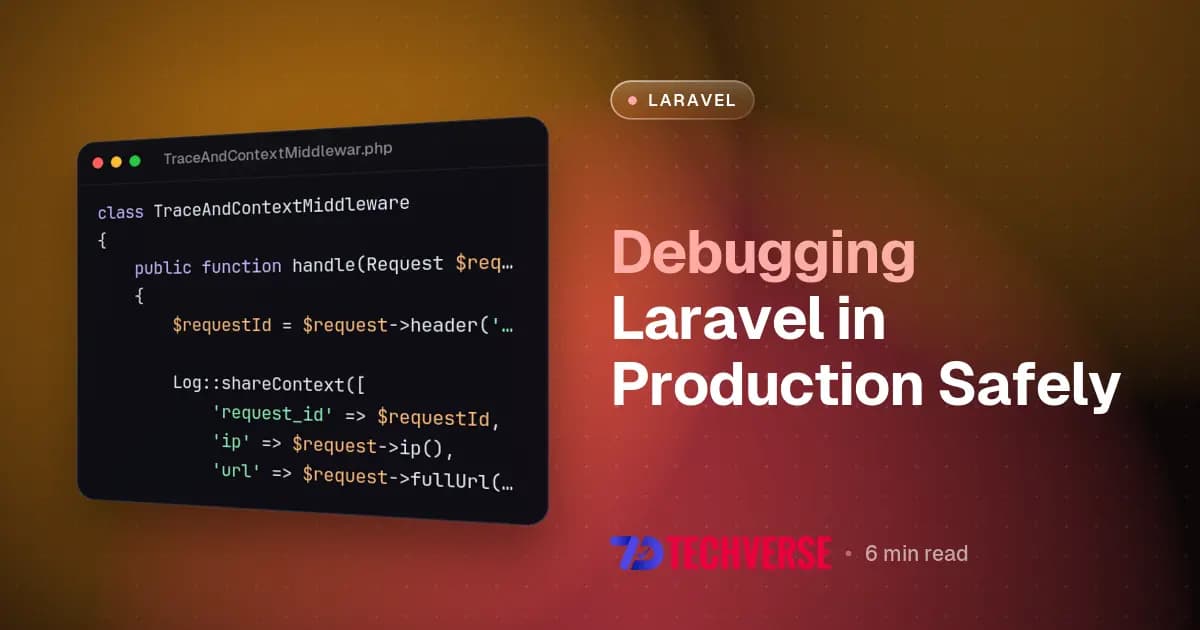
Laravel 12 provides Log::shareContext() to push contextual key-value pairs into all subsequent log entries generated during that request or queue job. Combine this with a custom HTTP middleware to attach incoming tracing headers from your Next.js 16 frontend.
<?php

namespace App\Http\Middleware;

use Closure;
use Illuminate\Http\Request;
use Illuminate\Support\Facades\Log;
use Illuminate\Support\Str;
use Symfony\Component\HttpFoundation\Response;

class TraceAndContextMiddleware
{
    public function handle(Request $request, Closure $next): Response
    {
        $requestId = $request->header('X-Request-ID') ?? (string) Str::uuid();

        Log::shareContext([
            'request_id' => $requestId,
            'ip' => $request->ip(),
            'url' => $request->fullUrl(),
            'method' => $request->method(),
        ]);

        if ($user = $request->user()) {
            Log::shareContext([
                'user_id' => $user->id,
                'tenant_id' => $user->tenant_id ?? null,
            ]);
        }

        $response = $next($request);
        $response->headers->set('X-Request-ID', $requestId);

        return $response;
    }
}
When Next.js 16 or React 19 applications issue requests via fetch(), pass a generated X-Request-ID header. The middleware captures this ID and embeds it into every log line Laravel writes. If a background job gets dispatched, pass that request ID into the job payload as well so queue workers keep the exact same trace ID.
Sanitizing Logs and Preventing PII Leaks
The fastest way to fail an audit or breach GDPR is calling Log::info('User update', $request->all()). A single form submission containing a password, credit card, or social security number will write raw PII straight into your log aggregator. Once written, deleting individual records from CloudWatch or Datadog is painful.
You can enforce automatic sanitization at the Monolog level. Monolog processors intercept every log record before it hits the handler, allowing you to recursively scrub sensitive keys. Here is a custom Monolog processor built for PHP 8.3 that scrubs sensitive keys from context arrays.
<?php

namespace App\Logging;

use Monolog\LogRecord;
use Monolog\Processor\ProcessorInterface;

class SensitiveDataScrubber implements ProcessorInterface
{
    /**
     * @var array<string>
     */
    private array $sensitiveFields = [
        'password',
        'password_confirmation',
        'credit_card',
        'card_number',
        'cvv',
        'authorization',
        'bearer_token',
        'secret',
        'api_key',
    ];

    public function __invoke(LogRecord $record): LogRecord
    {
        $context = $record->context;
        $cleanContext = $this->scrubArray($context);

        return $record->with(context: $cleanContext);
    }

    private function scrubArray(array $data): array
    {
        foreach ($data as $key => $value) {
            if (is_array($value)) {
                $data[$key] = $this->scrubArray($value);
            } elseif (is_string($key) && $this->isSensitive($key)) {
                $data[$key] = '[REDACTED]';
            }
        }

        return $data;
    }

    private function isSensitive(string $key): bool
    {
        $normalized = strtolower(str_replace(['-', '_'], '', $key));
        foreach ($this->sensitiveFields as $field) {
            $cleanField = str_replace(['-', '_'], '', $field);
            if (str_contains($normalized, $cleanField)) {
                return true;
            }
        }

        return false;
    }
}
Register this processor in config/logging.php on your production channels:
'stderr' => [
    'driver' => 'monolog',
    'handler' => Monolog\Handler\StreamHandler::class,
    'formatter' => Monolog\Formatter\JsonFormatter::class,
    'with' => [
        'stream' => 'php://stderr',
    ],
    'processors' => [
        App\Logging\SensitiveDataScrubber::class,
    ],
],
Structuring Log Outputs for Container Environments
In production container environments like Kubernetes or AWS ECS, writing logs to local files inside storage/logs/laravel.log is an anti-pattern. Ephemeral storage fills up quickly, rotating log files consumes disk I/O, and container restarts wipe local history. Production logging should emit JSON formatted strings to php://stderr or php://stdout.
JSON logs allow ingestion pipelines like FluentBit, Vector, or Logstash to parse log levels, context fields, and trace IDs without regex parsing. Here is a practical comparison of standard file logging versus JSON stdout logging under high traffic:
- Default File Logging (single/daily): Synchronous disk writes on the application thread. High lock contention under concurrent traffic. Parsing requires complex multiline regexes.
- JSON Stdout Logging: Unbuffered standard error streams captured directly by container runtimes. Zero disk file management in PHP. Pre-formatted JSON maps directly to Elasticsearch or Datadog indexes.
For high-throughput systems processing over 1,000 requests per second, synchronous network logging handlers (like direct HTTP syslog endpoints) introduce latent latency. If your log collector endpoint stutters for 200ms, your PHP worker hangs for 200ms. Always log to stdout or local socket daemons asynchronously, letting the host daemon manage buffering and network retries.
Handling HTTP Client and Exception Context
Laravel's HTTP client built on Guzzle is another common place where tokens leak into logs. If you enable request logging on Http::withToken('secret-api-key') without filtering, Monolog captures the HTTP authorization header. When configuring HTTP client middleware or logging third-party API calls, explicitly scrub authorization headers or use native HTTP client stubs during integration tests.
Exception handling in Laravel 12's bootstrap/app.php allows customization of exception reporting without polluting controller code. You can inject diagnostic details into error logs selectively:
->withExceptions(function (Exceptions $exceptions) {
    $exceptions->report(function (PaymentFailedException $e) {
        Log::channel('payments')->error('Payment capture failed', [
            'gateway' => $e->getGateway(),
            'amount' => $e->getAmount(),
            'error_code' => $e->getCode(),
        ]);

        return false;
    });
})
Returning false from an exception report callback halts further handling for that exception type, preventing duplicate logs from flooding your default channel while ensuring dedicated payment channels capture clean data.
Front-End Integration with Next.js 16 and React 19
When debugging full-stack applications, the disconnect between client errors and API logs costs hours. In React 19 server components or Next.js 16 API routes, maintain request context end-to-end. Generate a trace identifier on the client or API gateway and forward it across every boundary.
In a Next.js 16 route handler or server component, wrap your fetch calls to include the request correlation header:
import { headers } from 'next/headers';

export async function fetchFromLaravel(path: string, options: RequestInit = {}) {
  const requestHeaders = await headers();
  const requestId = requestHeaders.get('x-request-id') ?? crypto.randomUUID();

  const response = await fetch(`https://api.yourdomain.com${path}`, {
    ...options,
    headers: {
      ...options.headers,
      'X-Request-ID': requestId,
      'Accept': 'application/json',
    },
  });

  if (!response.ok) {
    console.error(`[API Call Failed] ${options.method || 'GET'} ${path}`, {
      status: response.status,
      requestId,
    });
  }

  return response;
}
By connecting Next.js server logs with Laravel backend logs using X-Request-ID, you can trace a single customer action from the React 19 interface straight through the database query in PHP 8.3.
What Never to Log in Production
Keep a clear list of data types that must never enter your log pipelines regardless of channel or environment:
- Raw Passwords and Tokens: Cleartext passwords, hashed passwords, database connection strings, access tokens, and bearer credentials.
- Payment Instrument Data: Credit card primary account numbers (PAN), CVVs, and bank account credentials. Logging PANs violates PCI-DSS compliance instantly.
- Personally Identifiable Information (PII): Passport numbers, national ID numbers, health records, and unencrypted full address data.
- Unfiltered Exception Objects: Avoid logging whole exception objects when custom drivers contain internal connection arguments or database connection arrays.
Structured laravel production logging gives you complete visibility while keeping customer data safe. By setting up middleware context, JSON output formats, strict Monolog processors, and correlation headers across Next.js 16, you will resolve production incidents in minutes instead of guessing in the dark.