Most Python microservices rely on standard framework dependencies for authentication. While that approach works fine for small applications, it introduces hidden bottlenecks when request volume scales into thousands of requests per second. Every endpoint evaluation triggers nested dependency trees. Parsing tokens repeatedly if not structured carefully will destroy your throughput. Building a custom middleware layer intercepts incoming requests before they hit the routing table. It gives you total control over state and authorization checks without bloating your service code. It's a direct way to handle transport-level security without paying the performance tax of heavy dependency resolution on every single route.
You need a clear separation between transport-level validation and application-level business logic. When dealing with JSON Web Tokens, validating signatures and extracting claims inside a traditional dependency can lead to duplicated database queries or unmanaged memory allocations. If you want to avoid scope leaks similar to those discussed in FastAPI Dependency Injection Scope Leaks in Production, moving your primary token verification up to the middleware boundary changes how resources are shared across async handlers. Don't let your route definitions handle low-level cryptography. That work belongs at the edge of your ASGI application stack where requests enter the process.
Implementing the Custom JWT Middleware Class
Middleware in this framework operates on raw ASGI scopes. You don't get the convenience of built-in dependency injection containers at this stage. This forces you to write clean, self-contained Python code. The middleware needs to extract the authorization header, verify the cryptographic signature using a library like PyJWT, and attach the decoded payload directly to the request state. If validation fails, it must short-circuit the request cycle and return a strict HTTP response immediately. It's an efficient pattern, but it means you're bypassing FastAPI's automatic exception handlers for these specific edge cases. You'll need to construct your error responses manually.
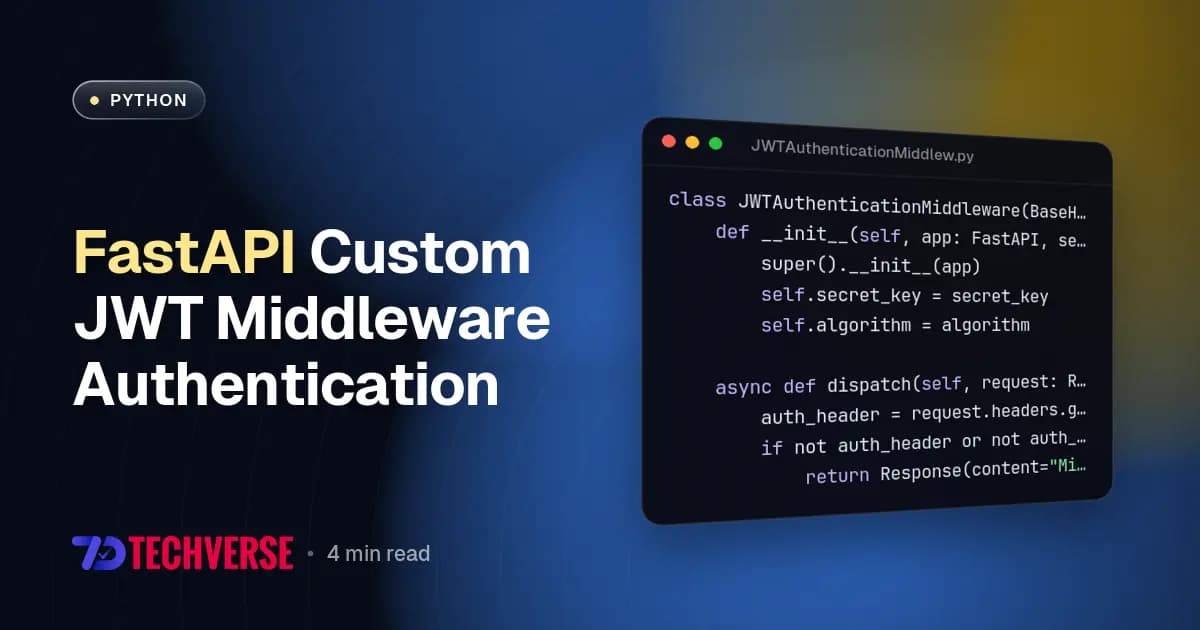
Let's look at a complete implementation of an ASGI middleware class that handles stateless token verification.
from fastapi import FastAPI, Request, Response
from starlette.middleware.base import BaseHTTPMiddleware
import jwt

class JWTAuthenticationMiddleware(BaseHTTPMiddleware):
    def __init__(self, app: FastAPI, secret_key: str, algorithm: str = "HS256"):
        super().__init__(app)
        self.secret_key = secret_key
        self.algorithm = algorithm

    async def dispatch(self, request: Request, call_next):
        auth_header = request.headers.get("Authorization")
        if not auth_header or not auth_header.startswith("Bearer "):
            return Response(content="Missing or invalid token", status_code=401)

        token = auth_header.split(" ")[1]
        try:
            payload = jwt.decode(token, self.secret_key, algorithms=[self.algorithm])
            request.state.user = payload
        except jwt.PyJWTError:
            return Response(content="Invalid authentication credentials", status_code=401)

        response = await call_next(request)
        return response
This snippet intercepts every request passing through the application stack. It reads the raw header string, strips the schema prefix, and decodes the token payload in memory. By attaching the resulting dictionary to request.state.user, downstream route handlers can access user metadata instantly without hitting any external datastore. You should manage your production dependencies carefully using practices outlined in Production Python Dependencies With UV and Lockfiles to ensure your cryptographic libraries remain pinned and secure. Don't skip pinning your packages. Minor releases in third-party parsers can occasionally alter exception behaviors and break your signature verification blocks silently.
Enforcing Role-Based Access Control Efficiently
Token verification alone only proves identity. Real microservices require granular permission checks to ensure clients only access resources matching their assigned roles. Instead of repeating role validation inside every route handler, you can combine your middleware state with a lightweight dependency helper. This keeps your endpoint definitions clean while centralizing authorization logic. It's a pattern that prevents code duplication across large teams working on dozens of microservices simultaneously.
Here is how you write a reusable dependency that inspects the user claims populated by the middleware earlier in the request lifecycle.
from fastapi import Depends, FastAPI, HTTPException, Request, status

class RoleChecker:
    def __init__(self, required_role: str):
        self.required_role = required_role

    def __call__(self, request: Request):
        user = getattr(request.state, "user", None)
        if not user:
            raise HTTPException(status_code=status.HTTP_401_UNAUTHORIZED, detail="Not authenticated")

        roles = user.get("roles", [])
        if self.required_role not in roles:
            raise HTTPException(status_code=status.HTTP_403_FORBIDDEN, detail="Insufficient permissions")
        return user

app = FastAPI()

@app.get("/admin/metrics")
async def get_admin_metrics(user: dict = Depends(RoleChecker("admin"))):
    return {"status": "ok", "restricted_data": [1, 2, 3]}
The combination of a raw ASGI middleware for signature verification and a callable dependency for role checks gives you the best of both worlds. The middleware acts as a gatekeeper, dropping unauthenticated requests before they consume unnecessary compute cycles. Meanwhile, the dependency enforces business rules declaratively on individual routes. When scaling services up, keeping your asynchronous loops healthy is critical. Refer to Diagnosing Async Python Event Loop Stalls if you notice latency spikes under heavy concurrent load. Event loop blockages will ruin your throughput numbers even if your authentication layer is lightning fast.
Handling Production Edge Cases and Gotchas
Watch out for common pitfalls when deploying this pattern in a real infrastructure environment. Forgetting to register the middleware before mounting your routers will leave your endpoints completely unprotected. Additionally, ensure your secret keys rotate securely through environment variables rather than hardcoded strings. If your service handles requests behind a reverse proxy, you'll also want to make sure your proxy doesn't strip or mangle the Authorization header before it reaches your ASGI application server.
Another subtle issue involves unhandled exceptions inside the token decoder. If the token contains unexpected claims or malformed structures that don't trigger standard PyJWT errors, your middleware might crash with a 500 status code instead of a clean 401. Always wrap your decoding block defensively and log unexpected exceptions to your error tracking system without leaking sensitive stack traces to the client. Memory leaks can also creep in if you store large objects inside the request state object across thousands of concurrent coroutines. Keep your payload contents minimal. Store only essential identifiers like user IDs and permission arrays rather than entire database model representations.