The Parallel Seeding Trap
Staging pipelines love speed. You spin up ephemeral containers, drop your tables, run migrations, and fire off concurrent database seeders to populate thousands of dummy records before your test suite kicks off. It works locally because your machine runs sequential loops. Once you push that workflow to a CI runner with multiple worker threads or parallel staging builds hitting the same shared database instance, the unique constraint violations start piling up.
Laravel database seeders assume absolute control over a single-threaded timeline. When two worker processes execute factory definitions simultaneously, both check for existing records at the exact same millisecond, find nothing, and attempt to insert identical unique slugs or email addresses. The database engine rejects the second write with a duplicate key error. You'll find it's a common issue when CI runners scale up horizontally without isolated database instances per job.
You can read more about data flow patterns in safe, resumable data backfills for Laravel if you're handling large operational batches. Most developers don't realize that standard seeders aren't built for distributed concurrency out of the box. They write seeders assuming they're the only process talking to the database. That's fine for local development on SQLite, but it breaks down on Postgres or MySQL in a hosted CI environment. You'll need to change how you construct database writes to survive parallel execution.
Ignoring this reality leads to flaky builds that fail randomly. One run passes. The next fails because worker two beat worker one by two milliseconds. Fixing this requires a shift from application-level logic to database-level guarantees.
Atomic Database Operations and Upserts
The standard Eloquent approach of checking existence before creation is fundamentally broken under concurrent execution. User::firstOrCreate() runs a select query followed by an insert query. That gap between checking and writing is where race conditions live. You need database-level atomicity to solve this.
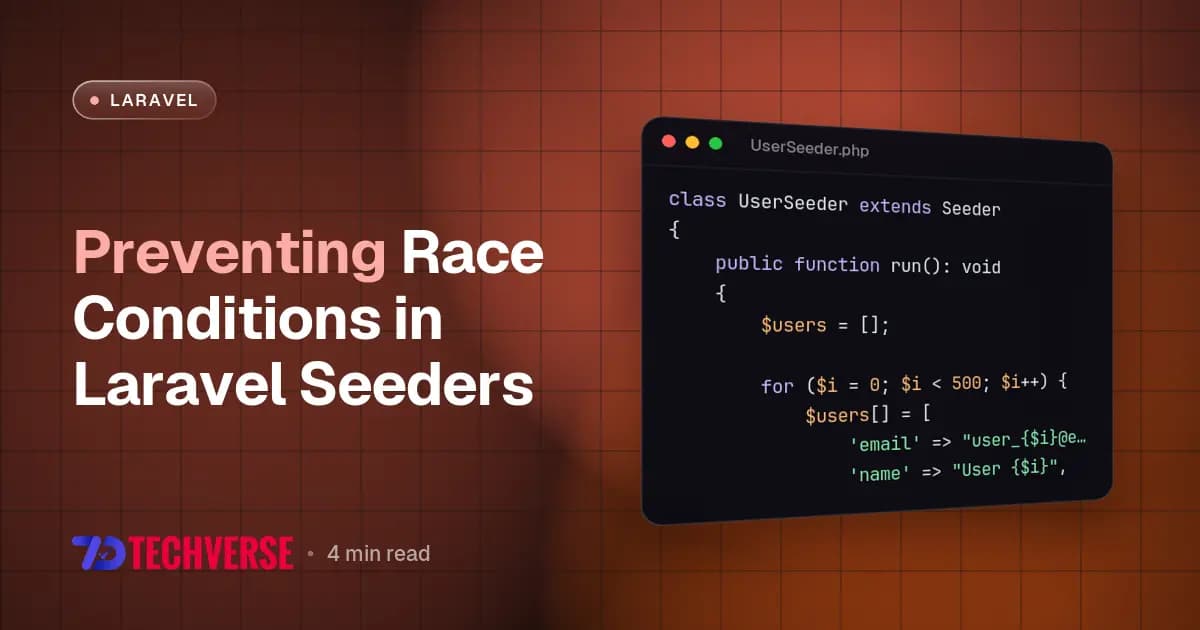
Laravel provides the upsert() method on the query builder, which lets you perform atomic insert-or-update operations based on unique index matching. Here's how you write a seeder that survives parallel execution without throwing integrity constraint violations.
<?php

namespace Database\Seeders;

use Illuminate\Database\Seeder;
use App\Models\User;

class UserSeeder extends Seeder
{
    public function run(): void
    {
        $users = [];

        for ($i = 0; $i < 500; $i++) {
            $users[] = [
                'email' => "user_{$i}@example.com",
                'name' => "User {$i}",
                'password' => bcrypt('password'),
                'created_at' => now(),
                'updated_at' => now(),
            ];
        }

        User::upsert(
            $users,
            uniqueBy: ['email'],
            update: ['name', 'updated_at']
        );
    }
}
The upsert command delegates the conflict resolution down to the underlying database engine via an ON CONFLICT or ON DUPLICATE KEY UPDATE clause. Because the database engine evaluates uniqueness checks within an exclusive internal lock during the insert phase, parallel processes won't step on each other. It's fast, clean, and avoids the trap of application-level existence checks.
You'll want to make sure your database table has a unique index defined on the columns you pass to the uniqueBy parameter. If the index isn't there, the database will throw a syntax or constraint error because it can't evaluate the conflict rule. Don't skip your database migrations when setting up seeders that rely on upserts.
Batching your arrays properly prevents memory exhaustion on large datasets. Feed arrays of a few thousand items at a time. The database handles the rest.
Using Database Locks for Complex Relationships
Factories that deal with complex polymorphic relations or dependent random lookups can't always rely on a clean upsert statement. If your seeder needs to fetch an existing category or create one if it's missing across multiple parallel threads, you need explicit transaction locking.
Wrapping your seeder logic in a database transaction with a shared lock prevents concurrent readers from modifying rows until the current transaction completes. Here's an example of locking category retrieval during parallel seeding runs.
<?php

namespace Database\Seeders;

use Illuminate\Database\Seeder;
use Illuminate\Support\Facades\DB;
use App\Models\Category;

class CategorySeeder extends Seeder
{
    public function run(): void
    {
        DB::transaction(function () {
            $categories = ['Engineering', 'Product', 'Design'];

            foreach ($categories as $categoryName) {
                Category::query()
                    ->where('name', $categoryName)
                    ->lockForUpdate()
                    ->firstOrCreate(['name' => $categoryName]);
            }
        });
    }
}
The lockForUpdate method issues a SELECT ... FOR UPDATE statement on the matching row. If another parallel seeder process is already inspecting or inserting that category, it pauses and waits for the active transaction to release the lock. This trades raw speed for absolute data integrity, which is a necessary trade-off when your CI pipelines scale horizontally.
If your application architecture involves heavy concurrent writes outside of seeders, you might also want to review strategies discussed in Laravel database transactions, deadlocks, and retries to handle transaction exceptions gracefully. Deadlocks can still happen if two transactions try to acquire locks in opposite orders, so keep your sort order consistent across all seeders and migrations.
You'll also want to configure your database connection timeouts appropriately. When multiple parallel jobs contend for the same row locks during staging initialization, connection pools can exhaust themselves if queries wait too long. Set a reasonable timeout value in your database configuration file so your CI pipeline fails fast with clear diagnostics instead of hanging indefinitely. Small adjustments here save hours of debugging broken builds.