Adding static analysis to a large legacy codebase feels like performing surgery on a live engine. You want the safety guarantees of a typed language, but turning on maximum strictness flags immediately buries your terminal in thousands of errors. Most of those errors are false alarms driven by untyped third-party libraries or dynamic dictionary lookups. If you want to succeed, you don't flip every switch at once. You crawl through modules systematically, using configuration boundaries to isolate the noise. It's a grueling process if you rush it.
You need to decide between two primary static analysis tools: Mypy and Pyright. Mypy is the veteran tool deeply integrated into the Python ecosystem, while Pyright is Microsoft's faster analyzer written in TypeScript and powers the internal checking inside Visual Studio Code. Both support PEP 484 type hints, but they handle missing imports and untyped functions differently. You can read more about foundational patterns in Python Type Hints and Mypy: Real World Patterns before writing any configuration files.
Establishing Baseline Configuration Files
Never run a type checker without a configuration file. Running flags directly in the terminal leads to inconsistent results across different developer machines and continuous integration pipelines. Create a pyproject.toml file in your project root to control how the tool evaluates your code.
[tool.mypy]
python_version = "3.15"
warn_return_any = true
warn_unused_configs = true
ignore_missing_imports = true

[[tool.mypy.overrides]]
module = "legacy_module.*"
disallow_untyped_defs = false
The critical setting here is the override block. By default, you want strict checks enabled globally, but legacy modules that lack any annotations will break your build. Setting disallow_untyped_defs = false for specific legacy paths lets you enforce types on new code while ignoring the technical debt sitting in older directories. As you refactor those legacy files, you simply remove them from the override list. It's that simple.
If you prefer Pyright, you configure it using a pyrightconfig.json file instead. Pyright offers granular control over execution environments and allows you to target specific subdirectories without touching the rest of the repository.
{
    "include": [
        "src"
    ],
    "exclude": [
        "**/node_modules",
        "src/legacy"
    ],
    "pythonVersion": "3.15",
    "typeCheckingMode": "basic"
}
Setting typeCheckingMode to basic rather than strict prevents the analyzer from complaining about missing type arguments on generic types or implicit Any casts. Once your core application runs cleanly under the basic tier, you bump that value to strict. Don't skip this tiering approach.
Gradual Module Integration Strategies
The biggest mistake teams make is trying to type-hint an entire codebase in a single pull request. Such massive PRs are impossible to review accurately and almost always merge runtime bugs disguised as type adjustments. Instead, you target a single package or file, add explicit annotations, and lock that file down so regressions cannot slip back in. It takes discipline.
Consider a utility module handling user data transformation. Before adding types, it accepts any dictionary and returns any dictionary, hiding potential KeyError exceptions at runtime.
def format_user_profile(data):
    return {
        "name": data["profile"]["full_name"],
        "active": data.get("is_active", False)
    }
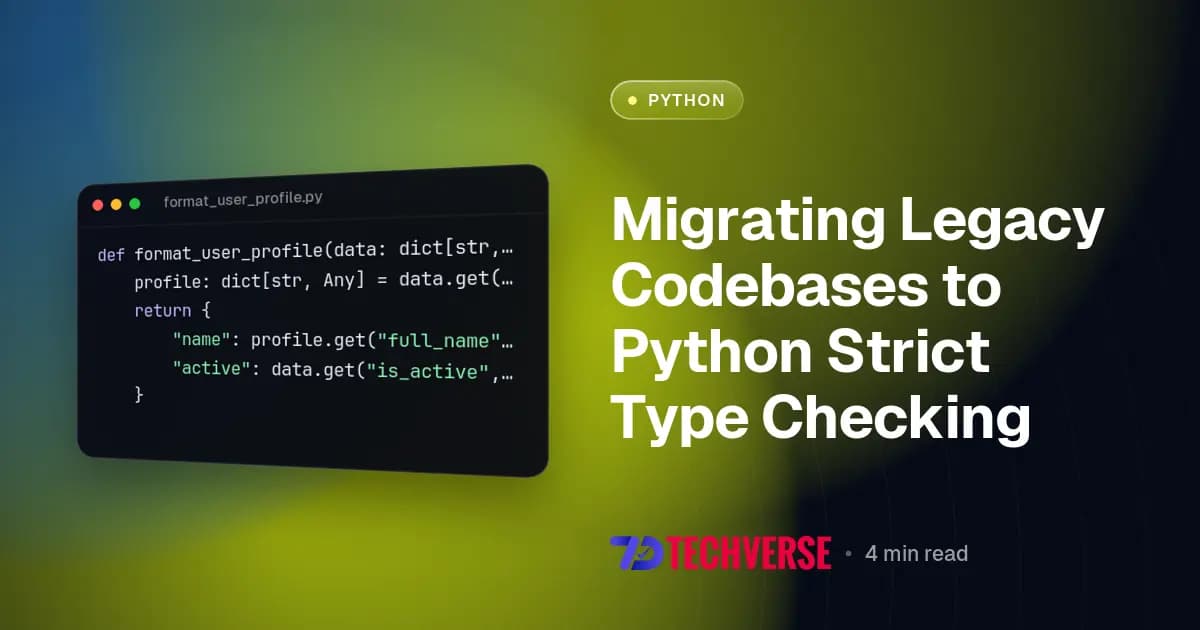
You rewrite this function by importing standard collection types and providing explicit parameter and return signatures. This process forces you to handle missing keys or nested dictionary structures safely.
from typing import Any

def format_user_profile(data: dict[str, Any]) -> dict[str, Any]:
    profile: dict[str, Any] = data.get("profile", {})
    return {
        "name": profile.get("full_name", "Unknown"),
        "active": data.get("is_active", False)
    }
After updating the file, you run Mypy pointing specifically at that file path to verify there are no hidden type mismatches. If your project relies heavily on background processes or asynchronous services, check out Diagnosing Async Python Event Loop Stalls to ensure your type annotations do not mask hidden blocking operations.
Enforcing Strict Checks in Continuous Integration
Once you clear a module or package of type errors, you must lock the achievement in your continuous integration pipeline. If you don't add the checks to your automated builds, developers will quickly reintroduce untyped code under deadline pressure. You configure your workflow to run the type checker alongside your test suite.
Add the checking command to your CI configuration file. If you use a tool like uv to manage your environment, you run the analysis directly inside the managed virtual environment without installing global binaries.
uv run mypy src/
If the command exits with a non-zero status code, the build fails immediately. This prevents unannotated code from reaching staging environments. When dealing with complex memory management or shared state across threads, pairing static analysis with proper resource management covered in Fixing Python Subprocess Resource Leaks keeps your production services stable under load.
Maintain patience during the migration window. Type checking is a tool for long-term maintainability, not an obstacle designed to slow down feature delivery. By isolating legacy codebases with configuration overrides and tackling modules one by one, you reach full strictness without disrupting production uptime. You won't regret the extra effort once the safety net holds.