Pushing a bad configuration change to a production web server ruins your afternoon. If you restart Nginx outright, you drop active TCP connections and trigger brief downtime. Doing a graceful reload prevents dropped requests, but only if the syntax check passes beforehand. You need a reliable workflow combining syntax validation, signal handling, and a fallback strategy when things break. Most administrators learn this lesson only after an accidental outage takes down a busy cluster during peak traffic hours.
You must understand how Nginx manages its worker processes to appreciate why a standard restart hurts your users. The master process reads configuration files and spawns worker processes to handle actual socket connections. When you restart the service completely, you terminate both the master and all workers, severing every active keep-alive connection instantly. Clients experience dropped requests, broken file uploads, and sudden connection resets. A graceful reload avoids this disaster by instructing the master process to spin up a fresh set of workers while the old workers finish draining their existing request queues.
Validating Syntax Before Touching Production
Before touching any service manager, run the configuration test. The binary accepts a specific flag for this exact purpose. It parses every directive, checks file paths, and validates upstream definitions against the system resolvers. If this command fails, your production service remains untouched. Don't skip this step, because it's your primary defense against bringing down public traffic with a misplaced curly brace or a typo in a server name.
nginx -tThe output tells you explicitly if the configuration blocks parse correctly. If there's a typo in a server block or a missing semicolon, the test exits with a non-zero status code and prints the exact line number. Never reload without running this check first. If you're automating deployments with tools like Ansible or custom shell scripts, wrap your reload command inside a conditional statement that checks the exit code of this test so you don't propagate bad files to disk.
nginx: the configuration file /etc/nginx/nginx.conf syntax is ok
nginx: configuration file /etc/nginx/nginx.conf test is successful
Sometimes a configuration passes the static syntax test yet fails to bind to a network port. This happens when you add a new server block listening on an IP address that isn't assigned to the local network interface, or when another application already occupies the target port. The syntax check command will return a success exit code in these scenarios, but the subsequent reload will fail when the new workers attempt to bind. Always inspect your error logs if a reload behaves unexpectedly after passing the initial parse phase.
Executing Graceful Reloads Without Dropping Traffic
Once the syntax check passes, you can instruct the master process to reload the configuration without dropping active worker connections. The master process reads the new configuration file, spawns a new set of worker processes with updated settings, and sends a graceful shutdown signal to the old workers. Old workers finish processing their current requests before exiting. This is where zero-downtime reloads actually happen under the hood, and it's why Nginx remains the preferred edge proxy for high-throughput environments.
You trigger this behavior by sending a specific signal to the Nginx master process. Systemd provides a convenient wrapper for this, but sending the signal directly via the process ID file is often more reliable in constrained container environments or custom deployment pipelines. Make sure you target the master process ID rather than the worker processes, or you'll crash the worker pool immediately.
kill -HUP $(cat /var/run/nginx.pid)Alternatively, systemd users can run the standard service reload command. Behind the scenes, modern service definitions map this command directly to the HUP signal or execute a pre-check script. If your system runs resource-heavy applications nearby, you might also want to look into profiling python finding the actual bottleneck to ensure your monitoring agents don't starve Nginx of CPU cycles during high-traffic spikes.
sudo systemctl reload nginxTiming matters during these reloads. If your upstream application servers take several seconds to process incoming payloads, ensure your worker shutdown timeouts match your application reality. If old workers are forced to exit before long-running API requests complete, clients still receive premature gateway errors. Adjusting worker shutdown timeouts inside your main configuration block gives legacy workers the breathing room they need to finish their jobs cleanly.
Handling Rollbacks When Operational Failures Occur
A successful syntax check doesn't guarantee a functioning production state. Sometimes an upstream service is down, or a TLS certificate path resolves correctly on disk but lacks the file permissions required for the worker user to read it. When a reload succeeds syntactically but fails operationally, you need an immediate rollback path. Keeping a versioned git repository inside your /etc/nginx directory lets you revert instantly without guessing which directive caused the regression.
Before running your deploy script, commit your current working state. If a reload causes errors in your error log or triggers HTTP five hundred responses from your upstream application, check the logs immediately. If you need to debug application-level bottlenecks behind Nginx, reviewing async python asyncio without the confusion helps clarify how non-blocking I/O behaves under load when requests back up during a failing proxy pass.
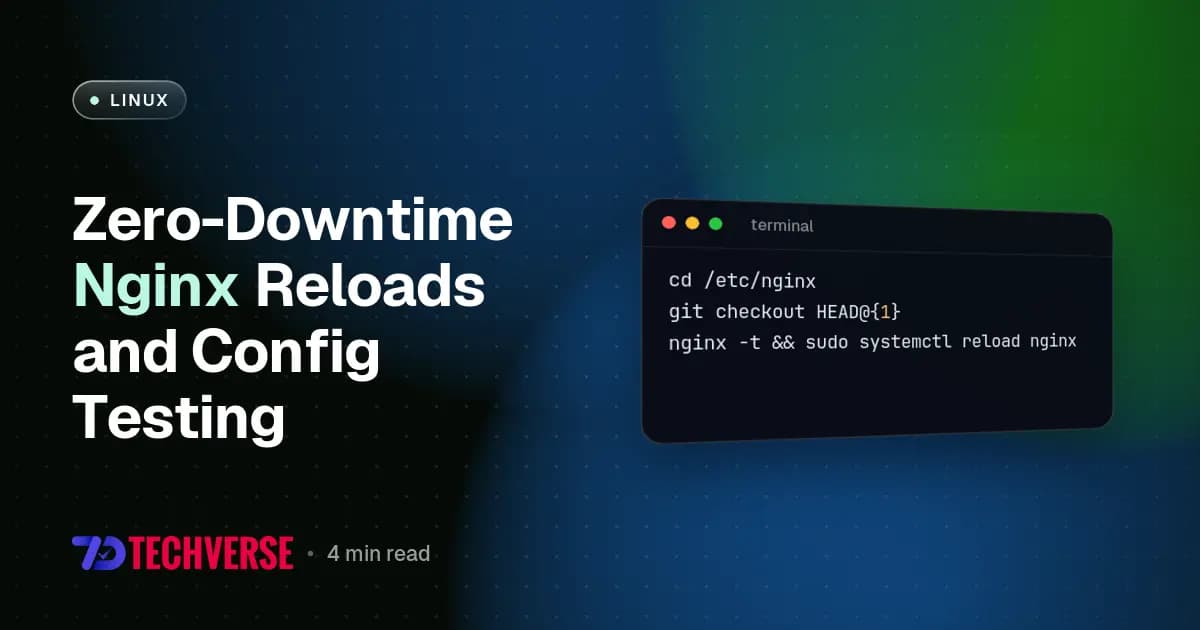
cd /etc/nginx
git checkout HEAD@{1}
nginx -t && sudo systemctl reload nginx
Automating this sequence inside a deployment script protects you from human error during stressful maintenance windows. Combine the syntax test, the reload signal, and a timed health check into a single execution block. If the health check fails within five seconds of the reload, force an automatic rollback to the previous commit hash. This minimizes human panic and keeps your service available while you investigate the broken upstream block offline.