This article gives you a practical, up‑to‑date overview of PHP 8.6—when it’s likely to ship and which language changes are most relevant to day‑to‑day PHP development. Instead of speculation, we focus on release patterns and RFCs that are either already accepted or actively under discussion for the next PHP 8.x cycle.
Everything here is framed around real code you’ll write in CLI tools, background workers, and web applications.
Expected PHP 8.6 Release Window
PHP has followed a very consistent major release cadence for several years:
PHP 8.4.0 → late November 2024
PHP 8.5.0 → November 20, 2025
Given this pattern, PHP 8.6 is most likely to ship in late November 2026. If the usual schedule holds, expect a Thursday release in the third or fourth week of November, most plausibly around:
November 19, 2026, or
November 26, 2026
The exact date will depend on how many release candidates (RCs) are needed before the final tag.
Features Accepted or Already in Progress
These RFCs are either accepted or actively being implemented and are the most likely to land in PHP 8.6.
Partial Function Application (v2)
Status: Accepted
Partial function application introduces a placeholder‑based syntax that lets you provide some arguments to a callable now and the rest later. When PHP encounters a placeholder (?), it returns a Closure capturing the provided arguments.
function add(int $a, int $b, int $c): int
{
return $a + $b + $c;
}

$add10AndX = add(10, ?, 5); // Closure expecting $b

echo $add10AndX(3); // 18
This is especially powerful in callback‑heavy code:
$strings = ['hello world', 'hello php'];

$replaceHello = str_replace('hello', 'hi', ?);

$result = array_map($replaceHello, $strings);
Type declarations are preserved, so invalid calls still trigger proper type errors. Edge cases exist around arguments passed by reference, so those should be reviewed carefully against the RFC.
RFC: https://wiki.php.net/rfc/partial_function_application_v2
clamp()
Status: Accepted
PHP 8.6 is expected to include a native clamp() function for constraining values within a range.
$percent = 140;

echo clamp($percent, 0, 100); // 100
If the value is below the minimum, the minimum is returned. If it’s above the maximum, the maximum is returned. Passing min > max is expected to throw a ValueError.
RFC: https://wiki.php.net/rfc/clamp_v2
RFCs Under Discussion for PHP 8.6
Everything below is still draft or under active discussion. Details may change, and inclusion in PHP 8.6 is not guaranteed.
func_get_args_by_name()
Status: Under Discussion
This RFC proposes a variant of func_get_args() that preserves argument names when named arguments are used.
function greet(string $name, int $age, ...$extra): array
{
    return func_get_args_by_name();
}

var_dump(greet(name: 'Alice', age: 30, 'x', 'y'));
Named arguments appear with string keys; extra positional arguments remain numerically indexed.
RFC: https://wiki.php.net/rfc/func_get_args_by_name
Nullable and Non‑Nullable Cast Operators
Status: Under Discussion
Two new cast forms are proposed:
(?type)→ allowsnull, otherwise applies strict coercion(!type)→ rejectsnulland invalid values
$value = null;

var_dump((?int) $value); // null

var_dump((!int) $value); // TypeError
These casts aim to make pipelines safer and reduce silent data corruption.
RFC: https://wiki.php.net/rfc/nullable-not-nullable-cast-operator
Deprecating Fuzzy Scalar Casts
Status: Under Discussion
This RFC targets lossy scalar casts, such as partially numeric strings.
$raw = "123abc";
$value = (int) $raw; // Expected to trigger a deprecation
The recommended pattern becomes explicit validation before casting:
if (!ctype_digit($raw)) {
   throw new InvalidArgumentException('Expected digits only');
}

$value = (int) $raw;
RFC: https://wiki.php.net/rfc/deprecate-fuzzy-and-null-casts
BackedEnum::values()
Status: Under Discussion
Adds a built‑in values() method to backed enums.
enum Status: string
{
  case Active = 'active';
  case Inactive = 'inactive';
}

Status::values(); // ['active', 'inactive']
RFC: https://wiki.php.net/rfc/add_values_method_to_backed_enum
Stringable Enums
Status: Under Discussion
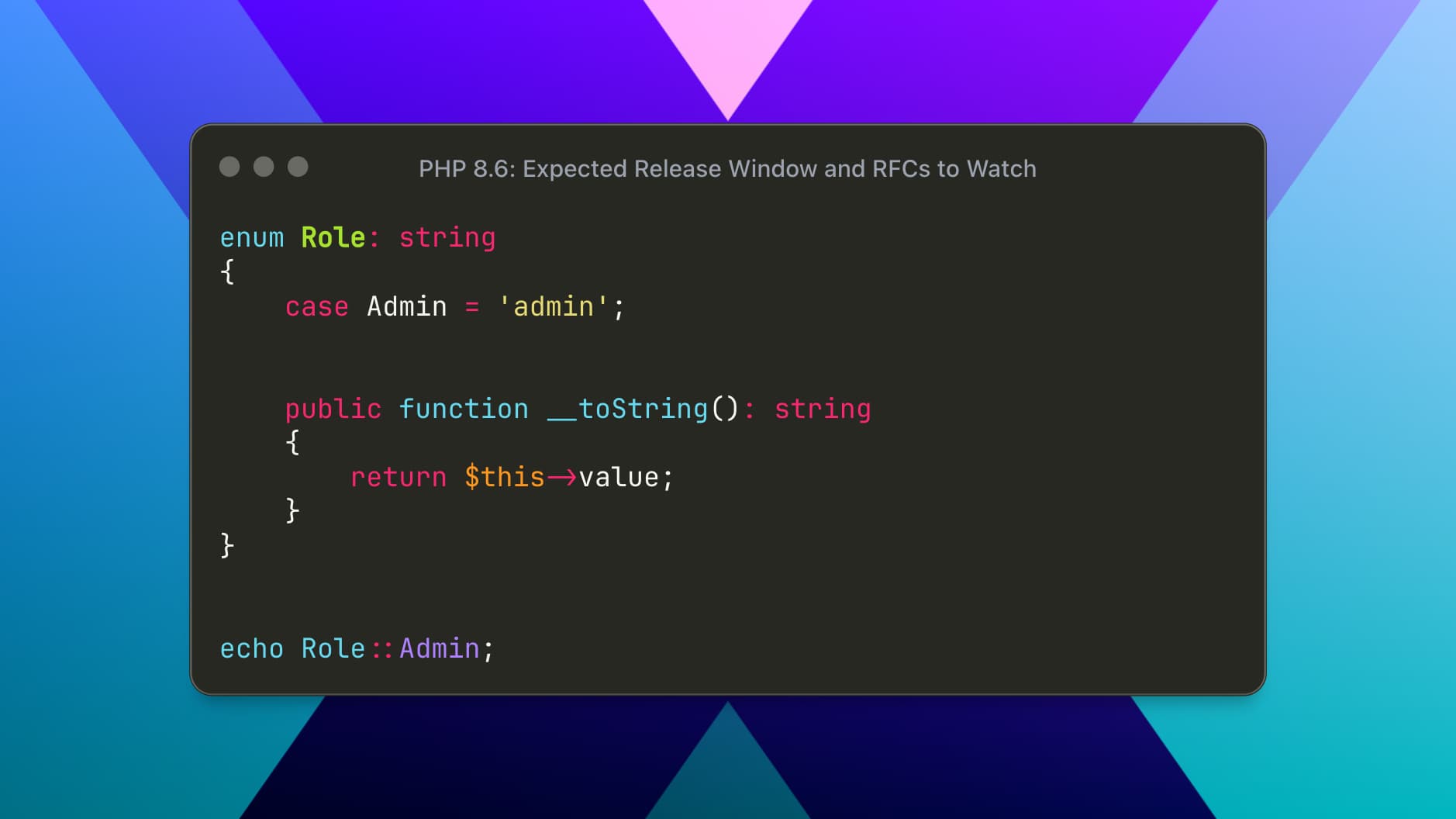
Allows enums to define __toString().
enum Role: string
{
  case Admin = 'admin';

  public function __toString(): string
  {
    return $this->value;
  }
}

echo Role::Admin;
RFC: https://wiki.php.net/rfc/stringable-enums
Additional RFCs to Watch
Stream error handling improvements
Data encoding API
Namespace‑scoped visibility
PDO::disconnect() and PDO::isConnected()
Object‑oriented curl API (v2)
num_available_processors()
Dropping official 32‑bit builds
JSON Schema validation
pack()/unpack() signed endianness modifiers
Context managers (
usingblocks)True Async (engine, scope, structured concurrency)
Each of these proposals targets long‑standing pain points, but many are large in scope and may land in later PHP versions.